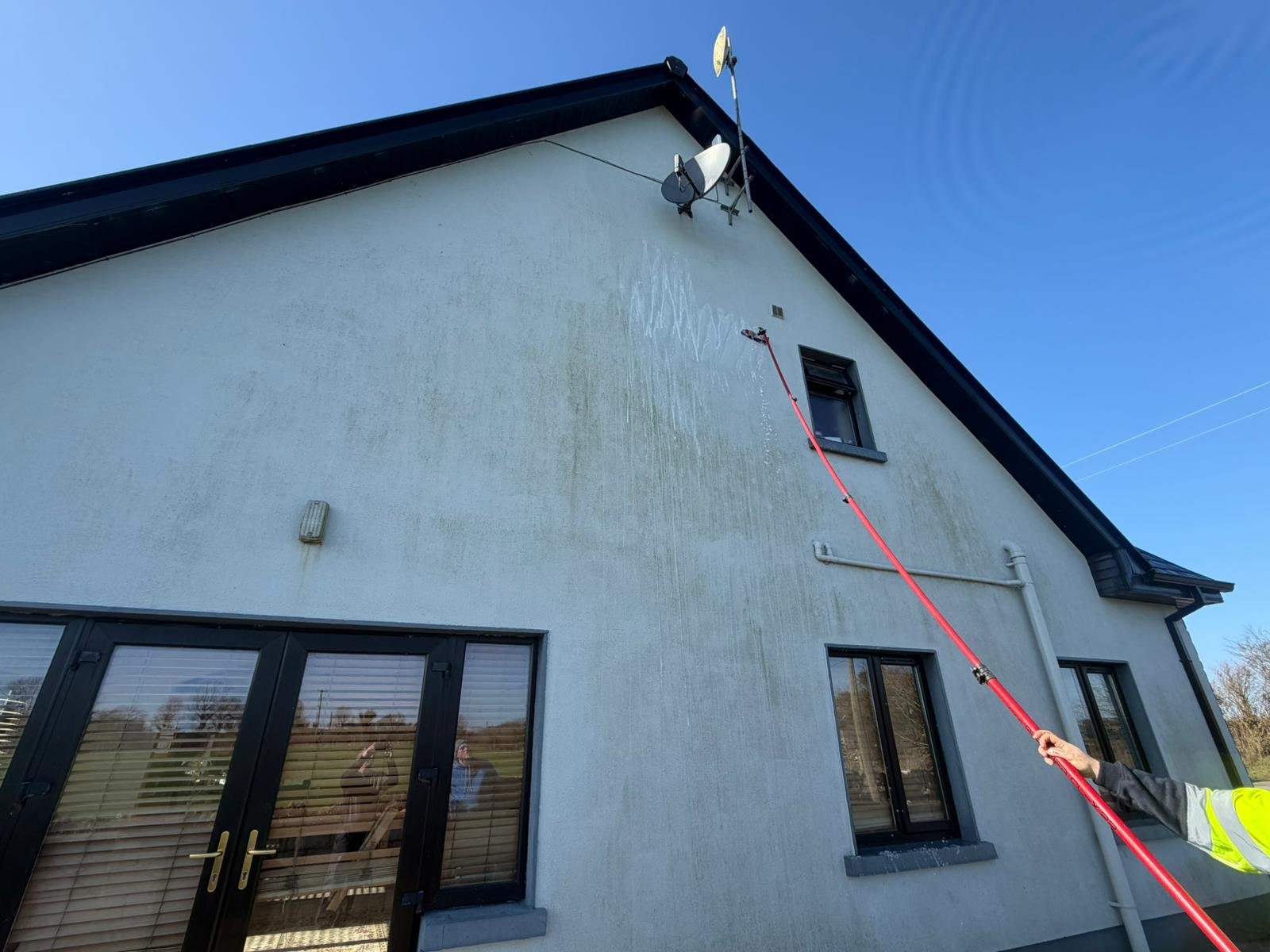
How should you approach cleaning algae from exterior walls in Ireland? Start by identifying the wall surface and checking why it stays damp. Rain, shade, hedges, blocked gutters and slow-drying north-facing elevations can all encourage green growth, so cleaning alone may not solve the cause.
Use a small test patch and the least aggressive suitable method. Render, painted walls, bare masonry, pebble dash and older lime-based finishes each need different care. For a wider look at methods, see soft washing versus pressure washing and our guide to seven uses for soft washing on Galway properties.
WestClean Property Care, based in Tuam since 2014, provides insured soft washing in Galway and across Mayo. Soft washing starts from €150 for a single wall, or from €350 for a terraced house, and includes a free exterior window clean. Commercial and larger jobs are quoted after we see the building. Every quote is free and without obligation — request a quote.
Frequently Asked Questions
Irish rainfall and persistent moisture give algae favourable conditions, particularly where walls receive little sunlight or air movement. A north-facing wall beside a hedge may stay damp for much longer than a sunny elevation. Green algae on render often appears strongest near the base, where splashback, poor drainage or dense planting slows drying.
Green staining isn't automatically algae. Moss, lichen, dirt, old paint and general weathering can look similar at a distance. The correct treatment depends on what is present and what lies underneath it. A visual inspection should come before any cleaning, especially on older buildings.
The Dublin local authority guide to the care of older buildings recommends regular inspection and compatible cleaning methods for vulnerable traditional surfaces.
Algae can retain surface moisture, make paths and lower walls slippery, and leave an unattractive green film. Repeated dampness may contribute to staining or deterioration in vulnerable render and paint, but the extent depends on the substrate, age, exposure and existing defects.
Exterior wall algae removal won't repair cracked render, flaking paint, failed joints, defective gutters, leaking downpipes or penetrating damp. A painted exterior with open cracks and loose paint needs repair planning and a test patch before full cleaning. Older or historic walls need a surface-specific approach rather than aggressive pressure washing.
Begin with an inspection. Check the wall type, paint condition, cracks, loose areas, nearby windows and drainage. Then test the proposed method on a small, inconspicuous patch. This is the safest way to judge how the surface reacts before treating a whole elevation.
A suitable process may involve protecting windows and nearby surfaces, applying a compatible treatment in a controlled way, and rinsing at low pressure where the wall allows it. Follow the product label and relevant safety data. Never guess chemical concentrations or dwell times.
Pressure alone can remove paint, damage weak render, drive water into cracks or spread dirty run-off. Soft washing exterior walls in Ireland can reduce mechanical stress in some situations, but "soft wash" does not make every chemical or surface automatically safe. Painted render, pebble dash, bare masonry, lime-based finishes and delicate planting all need separate consideration.
A commercial render cleaning checklist should cover the building before, during and after the work. It is practical guidance, not a complete statutory compliance list. Commercial sites, schools and public areas may also require a site-specific risk assessment and method statement. For larger elevations, see also commercial cleaning in Galway City and façade cleaning.
- Before work: identify the render type, inspect cracks and loose areas, photograph existing damage, confirm safe access, and note vulnerable details.
- Protect the site: cover or isolate windows, doors, vents, signs and electrical fittings; protect planting; manage pedestrians; confirm water access and agree working hours with the building manager.
- Control run-off: plan where cleaning water will go and protect drains, neighbouring property, ponds and entrances from contaminated or chemical-treated water.
- After work: inspect for missed staining, remove residue, check splash marks, photograph the completed elevation and record repairs needed before the next clean.
The Department of Education's maintenance guidance for all schools, published on 4 June 2024, supports a planned maintenance regime for school buildings and external spaces. Keeping inspection notes and photographs makes recurring defects easier to track.
Pressure washing may suit a hard, sound surface, but it is a poor default for many rendered walls. Use extra caution if the render sounds hollow, the paint flakes, cracks are open, joints are failing, or the finish is old lime-based material.
Soft washing versus pressure washing isn't a choice made by brand name; it depends on the substrate and its condition. Choose the least aggressive method that can remove the growth, then confirm it with a test patch. The older-buildings guidance linked above supports careful inspection and compatible cleaning rather than one method for every wall.
Safe algae removal from walls requires suitable eye and skin protection, stable access, care around electricity, and protection for windows and vents. Keep people away from wet work areas and follow the treatment product's label. Commercial, school and public-access sites need a site-specific risk assessment.
Control algae treatment run-off before work begins. Protect drains, planted areas, ponds, pets and neighbouring property, and don't allow residue to run across pedestrian routes. Common green wall staining should not be described as toxic without identification, but unidentified biological growth deserves caution. The review "Toxic or Otherwise Harmful Algae and the Built Environment" discusses the distinction between ordinary surface growth and potentially harmful algae or cyanobacteria.
Reduce regrowth by keeping gutters and downpipes clear, repairing leaks, cutting back vegetation that blocks drying, and checking joints and seals. Cleaning cannot correct a drainage defect, so record any source of repeated dampness while the wall is accessible.
For example, a property manager can record the cleaned north-facing elevation, note the hedge and downpipe condition, then check the same area during the next scheduled maintenance visit. Shaded walls may need periodic inspection because no single clean can promise a fixed period without regrowth.
The Department of Education guidance supports planned maintenance for school buildings, while the older-buildings guide supports regular inspection and suitable care for traditional surfaces.
Arrange professional assessment for multi-storey walls, large commercial elevations, fragile render, difficult access, recurring damp staining or sites open to the public. A useful quote should state the surface assessment, proposed method, access arrangements, protection measures, run-off controls and exclusions.
For a render or wall clean, give the wall condition, access limits and any known gutter or damp problems when requesting a quote.
Get a soft washing quote
WestClean Property Care is based in Tuam since 2014 and provides insured exterior cleaning, including soft washing, across Galway and Mayo. Soft washing starts from €150 for a single wall, or from €350 for a terraced house, with a free exterior window clean. Commercial work is quoted individually. Get a free, no-obligation quote.
References
- Maintenance guidance for all schools (Department of Education, 4 June 2024)
- A Guide to the Care of Older Buildings
- Toxic or Otherwise Harmful Algae and the Built Environment (doi:10.3390/toxins13070465)
Book This Service in Galway
We cover Galway City and all of County Galway. See our local pages:
Need Professional Help?
Get a free, no-obligation quote for your home or business in Galway or Mayo.